Hello. We like to collect well-designed vintage pottery (and lots of other stuff) from the 1950s,
'60s and '70s. Here are some pictures and info of a selection of the things we've found.

Showing posts with label 1970s. Show all posts

Wednesday, 19 November 2014

Twin Bird, Japan. Retro home bar accessories. 1970s


If you're lucky enough to have a home bar, and your home bar is styled in a retro theme, then here's the very thing for you.

A fabulously retro water jug and matching ice bucket. The metal jug and ice bucket have semi-transparent lids, plastic liners for double insulation and are in a bright lime green colour. The ice bucket is marked Twin Bird on the base. Probably made in Japan in the 1970s, these two eye-catching home bar accessories would look great next to a bowl of lemons and limes.

In fact, they look so good, I'm off to build my own bar right now. Cheers.

PS We've opened a little shop on Etsy. You can see it here: Potshots on Etsy 

Monday, 10 November 2014

Soholm dish. Blue Series, Einar Johansen. Simple but nice.


A simple but pleasing little serving dish or trinket tray by Soholm, Denmark.

The dish is from the Blue Series, designed by Einar Johansen, It probably dates from the 1960s or early 1970s. The glaze contrasts are specially nice - a rich glossy dark blue with tones of earthy brown on the inside, the outer walls in a semi-matt black, almost leather-like, finish. The inner base of the dish is indented with a simple triangular repeat pattern. All of which, makes this item pleasing on the eye, and to the touch.

Simple but nice.

Thursday, 23 October 2014

An abstract serving on this vintage platter. Poole Delphis.


A platter with such a generous serving of abstract design. This vibrant charger is full of fun and full of colour. It's from the Poole Delphis range and was probably made in the late 1960s or early 1970s. The pointed shape is known as shape 91. Unfortunately the plate is not signed so I'm not sure who the artist was - which is a shame because such an expressive technique deserves recognition.

An interesting and eye catching plate, for sure.

Friday, 8 February 2013

1970s playtime. Make your own sculptures with Galt Octons


How cool is that?

I made it all by myself, you know.

Forgive me but I've been messing about with a vintage toy I found recently. And great fun it is too.

In the age of complicated electronic toys and games, who would have thought you could get so much pleasure from something as simple as creating sculptures from bright coloured, interlocking, plastic octagons. They do say simple things amuse simple minds.

Funnily enough though, what you could end up with is a very stylish object: a visual, light catching sculpture that would look superb on display in the window area of a modern interior. And your sculpture is, of course, infinitely variable for when you feel like a change.

The toy is Octons by UK manufacturer, Galt Toys. I would guess this version dates from the 1970s.

C'mon, don't pretend you wouldn't like a go too.

(Added 27 June 2013) It looks like Galt Toys are still going strong today - and they're still making a version of Octons: Galt Octons

Monday, 7 January 2013

Mdina bottle vase and stopper.


Some time ago I did a blogpost on a couple of Mdina vases. Remember this: Mdina vases

I said then that I'd try to show some more Mdina. Well, better late than never.

This Mdina bottle vase and stopper has been in the Potshots collection for a quite a while now so, as I was photographing some items of glassware the other day, I decided to do a quick shot of it for the blog-site. I'm glad I did because the shot turned out quite well. It's probably because the colours in the glass are so good and the shape is so well proportioned. I specially like the flattened out top on the neck of the vase. And those swirls of colour in the body of the glass.

I would guess the vase dates from the 1970s.

Thursday, 27 December 2012

Three Scheurich retro winter warmers

 
Something to add a bit of warmth to a winter day.

There are Dancing flames, fire-red colours and bubbling lava flows on these vintage West German vases.

I have an idea they are all by Scheurich and they probably date from the 1960s or 1970s. Grouped together, they certainly help to warm up a retro-styled interior.

There seems a lot more information available on West German pottery these days - and some very keen collectors. There are some amazing images and lots of good info on one of my favourite blogs, here: Blurat West German pottery

Thursday, 13 December 2012

Troika. A work of art whichever way you look at it.


Vase, sculpture, art? To me, this tall Troika vase qualifies as all three.

And the nice thing about having a vase that's square like this one, is that – depending which face you choose to display – it's a bit like having four different vases in one.

This carved and wonderfully textured vase in warm earthy colours is by Troika Pottery. The design is by Tina Doubleday who was at Troika between 1977 and 1979.

There's a lot more information on Troika pottery, including a useful list of designers marks, here: Troika Pottery

Friday, 30 November 2012

Colourful and sculptural. 1970s Carltonware.


Back to the pottery. And what better way than with a zing of colour from the 1970s.

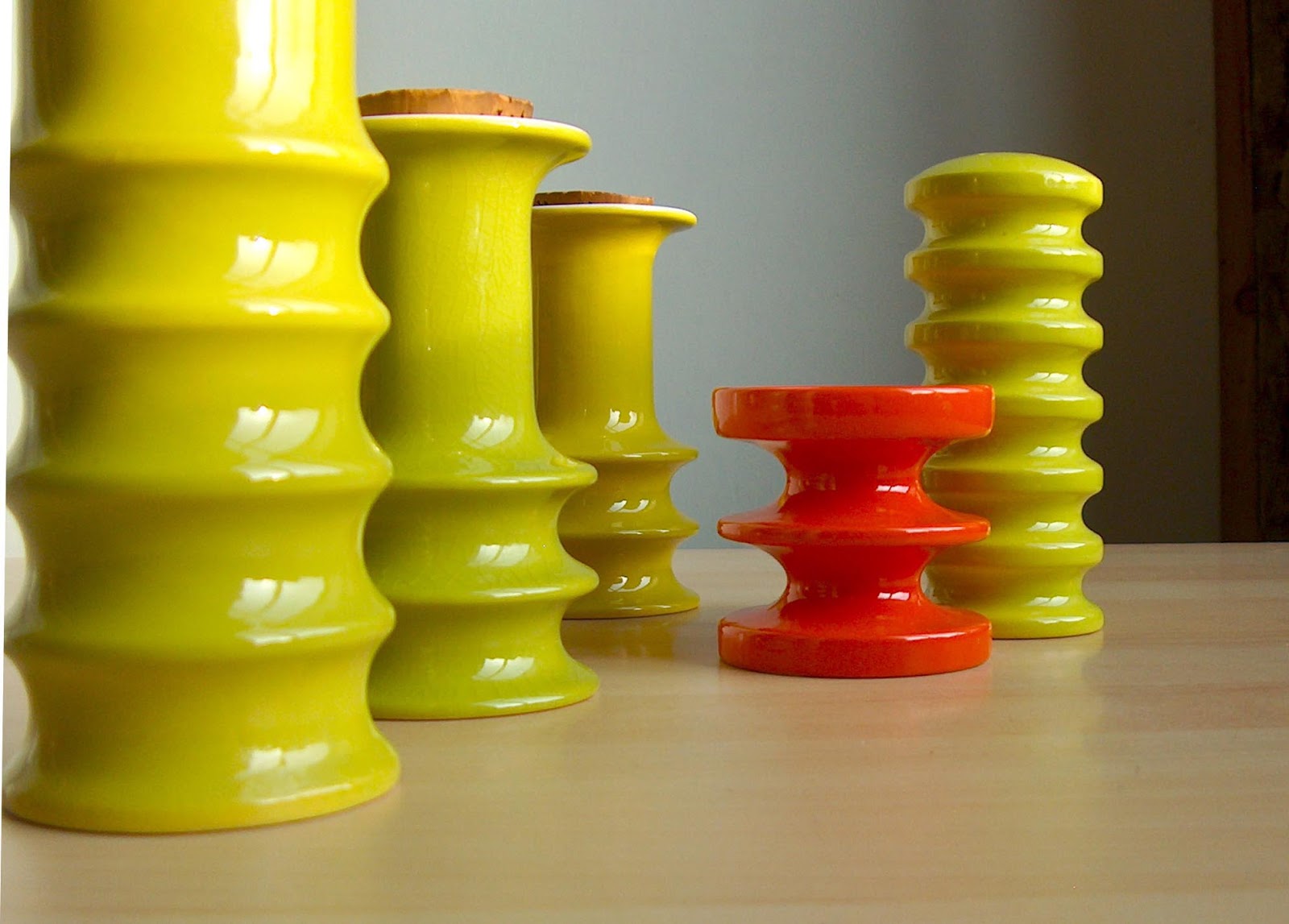
These artful creations are by Carltonware and they probably date from the 1970s. In Acid green, lemon yellow and bright red, this tableware looks wonderfully sculptural with those stacked ring shapes. There are two vinegar or oil bottles, the small red item is a candle holder, the round top item is a pepper pot and the tallest pot is a vase.

Even if you didn't want to use them on a table setting, I think they look so good together as a group, you could simply put them out on display and enjoy them as little works of art.

Tuesday, 30 October 2012

Italian lamp bases. This Bitossi pair will soon to see the light.


I suppose it's criminal of me not to be using these smart Italian lamp bases. Both have fittings and are fully wired – they just need a plug and a suitable shade and they'd be ready to go. It's a shame not use them so I promise to get that done soon.

The lamp bases are a couple more examples of vintage Bitossi pottery from circa 1960s or 1970s. As regular visitors will already know, like a moth to light, I seem to be helplessly attracted to cylinder shaped pottery – remember this: Cylinder vases

The Bitossi factory is probably more associated with the Rimini Blue pottery but they also made some fabulous items in reds, yellows, oranges and other colours. The orange and brown lamp base shown here has the characteristic bands of impressed motifs that are used on the Rimini Blue range and that give such a wonderful surface texture.

Tuesday, 23 October 2012

Murano faceted vases c.1970s.


Italy again. This time in the form of some crisp glassware.

These vibrant, geometric vases are from Murano. They are probably by the Mandruzzato glass works and I think they were made in the early 1970s. Eye-catching they are too, with cased layers of red, gold and clear glass. The polished, faceted surfaces give a cold, hard feel and an ultra-modern look of purity.

Although Murano faceted vases were made in various colours, I particularly like these bright red examples.

There's lots more information on faceted glassware (and other 20th Century glass) here: Mandruzzato glass

Friday, 12 October 2012

Rimini Blue vases by Bitossi. Rediscovered


Last week I had to clamber up into the loft space to bring down some suitcases. Whilst I was up there, I couldn't resist peeping into a couple of storage boxes that I put up there two or three years ago. Look what I found in one of the boxes: this selection of wonderful Italian pottery. As I hadn't seen these since the day I'd stored them away, it was like meeting a long-lost friend again.

As far as I know, the range is known as Rimini Blue (or Rimini Blu) and they were made in Italy by Bitossi. Dating this type of pottery is a little more difficult. I have a feeling this range has been produced since the early 1950s, but that some items are still in production today.

The shapes, the fabulous blue/green colour, and the textures are all a joy on the eye.

I have a feeling I have some examples of Bitossi pottery in reds and oranges put away somewhere – I can feel another trip to the loft coming on.

Friday, 22 June 2012

Let's face it. These cruets are absolutely spiffing


And to follow on from the Carltonware cat, I think these amusing face cruets are just fab.

Made by Carltonware in the 1970s, I have an idea they're from a range designed by Vivienne Brennan.

The monocled gentleman is a pepper pot, his hat is the salt pot. The maid salt pot has the butler's face on the reverse and the butler pepper pot has the maid's face on the reverse.

The three-colour illustrations are beautifully done and they work so well on the simple shapes of the white pottery.

Tuesday, 5 June 2012

Carlton Ware cat money box.


My last blogpost featured a cute pottery dog, the one before that an elegant Tigris cat, so to keep the theme going here's another cat.

This time the cat is in the form of a pottery money box. Made by Carlton Ware (or is that Carltonware?), I would guess in the early 1970s, I think the money box is from a range designed by Vivienne Brennan.

The bold illustration on this money box is in bright red and orange. I've seen examples of the same money box in different colour schemes.

There are some more good images of Carlton Ware money boxes from the 1970s on Pips Trip, here: Carlton Ware on Pips Trip

Tuesday, 29 May 2012

Briglin Pottery dog


Sorry. It's been quite a while since I did a blogpost so here's a cute little dog to look at while I dig out some more Potshots goodies.

The dog is by Briglin Pottery, remember this: Briglin Pottery

I like the texture of the carved hair and the way that those hollow eyes give him (or her) a comical blank expression.

Saturday, 25 February 2012

Whitefriars glass at its bobbly best.


Joy of joys. I was lucky enough to find another knobbly vase to add to my slowly growing collection of coloured cased glass. I rescued the tall kingfisher blue vase from a second-hand shop earlier this week.

I say 'vase' but since I started to research this type of glassware, I have seen this tall, slim shape described as a lamp base. I'm fairly sure that all three of these glass beauties are by Whitefriars and are from a range designed by William Wilson and Harry Dyer in 1963. Known, for obvious reasons, as the Knobbly range, they were in production between 1964 and 1972. The Whitefriars Knobbly vases and lamp bases were made in a range of plain cased colours, like these, and also in a range of attractive streaky colours.

The vases are satisfyingly heavy and are as good to handle as they are to look at. All the surfaces are irregular, randomly bobbled and are silky smooth to touch. Even the neck openings are rounded and smoothed off. This type of vase must be a dream for interior decorators – they look so good in almost any setting. I particularly like the way you get a glimpse of the clear glass at the base and at the edges. And when you get a couple of different colours together, the effect can be quite stunning....

Tuesday, 7 February 2012

Cathrineholm Lotus enamelware.


You don't have to hide away your pots and pans in cupboards when they look this good.

If you can find vintage enamelware in good enough condition, and at a sensible price, it's worth picking up. The problem is, it seems to be getting harder to do that, these days. Enamelled metal pots, pans and bowls, like these, look really good displayed on an open kitchen shelf. It's no wonder keen collectors are now snapping up all the best pieces. This type of enamelware is well-made and comes in some fabulous colours and designs.

Most of the examples shown here are in the popular and very beautiful Lotus pattern produced by Cathrineholm, Norway in the 1950s and 1960s. Often the Lotus pattern is attributed to designer Grete Prytz Kittelsen (1917 – 2010), but there seems to be some doubt as to whether she was the actual designer.

Whoever the designer was, I'm a big fan. And so is MidCenturyMama, she has some great photos of her Cathrineholm collection, here: Cathrineholm lovers

Monday, 16 January 2012

Textured vase by Geoffrey Baxter for Whitefriars


And here's another tangerine beauty that perhaps deserves a blog-post to itself.

This fine example of 1960s/1970s Whitefriars glass has a wonderful shape, colour and texture. The shouldered neck that mirrors the foot at the base, the vibrant orange colour and the concentric rectangular pattern with the bobbly surface texture give this vase real style. Bright, bold and solid.

The vase is known by Whitefriars collectors as the 'TV' vase but I'm not sure why. Designed by Geoffrey Baxter, this shape of vase was in production from around 1967 to roughly 1973. As well as being made in a range of bright colours – Tangerine, Kingfisher Blue, Meadow Green – there were also TV vases made in more subtle, natural shades, such as Pewter Grey.

There's a lovely Kingfisher Blue example in the Bristol Blue Glass Museum, you can see it here: Blue Whitefriars vase

Friday, 13 January 2012

Whitefriars glass. A tangerine dream.


How about a burst of colour to kick off the new year? And these three small glass vases certainly give us that.

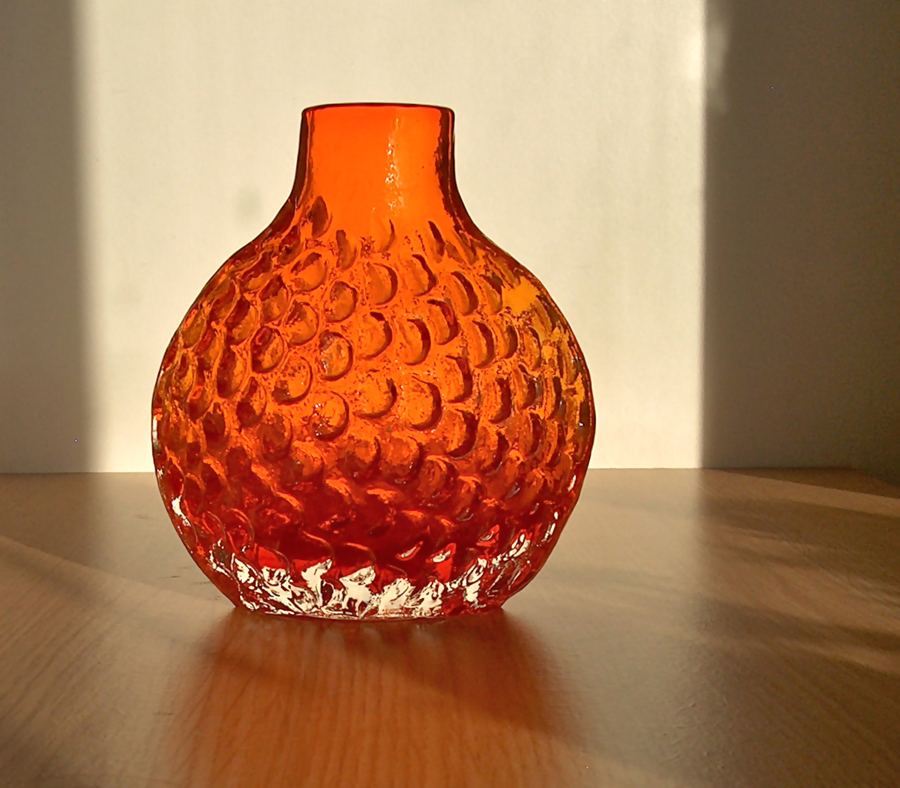
These smart, chunky vases are by Whitefriars and all date from the early 1970s. Not only do the vases have the intensity of that wonderful deep orange colour, they also have such nice surface textures. The square vase has a raised spiral decoration, known as Greek Key, the bulb-shaped vase (known as the Onion vase, I think) is covered in large impressed blobs, and the taller vase has a lovely tactile 'tree bark' surface. The orange colour is known as Tangerine by Whitefriars collectors – and, not surprisingly, there are quite a few of those. There's an excellent collectors site with lots of information on Whitefriars glass, here: Whitefriars collectors site

I can see why Whitefriars glass is as popular as it is. If these three small vases look so good displayed together, you can imagine what impact a couple of large pieces would have.

P.S. If, because of my title, you accidentally arrived here expecting to find something on Tangerine Dream, the mighty fine German electronic music group, my apologies. You could try here: Tangerine Dream official website